Upstash
FreemiumServerless Redis and Kafka with per-request pricing, global replication, and REST API — designed for serverless and edge computing environments.
What does this tool do?
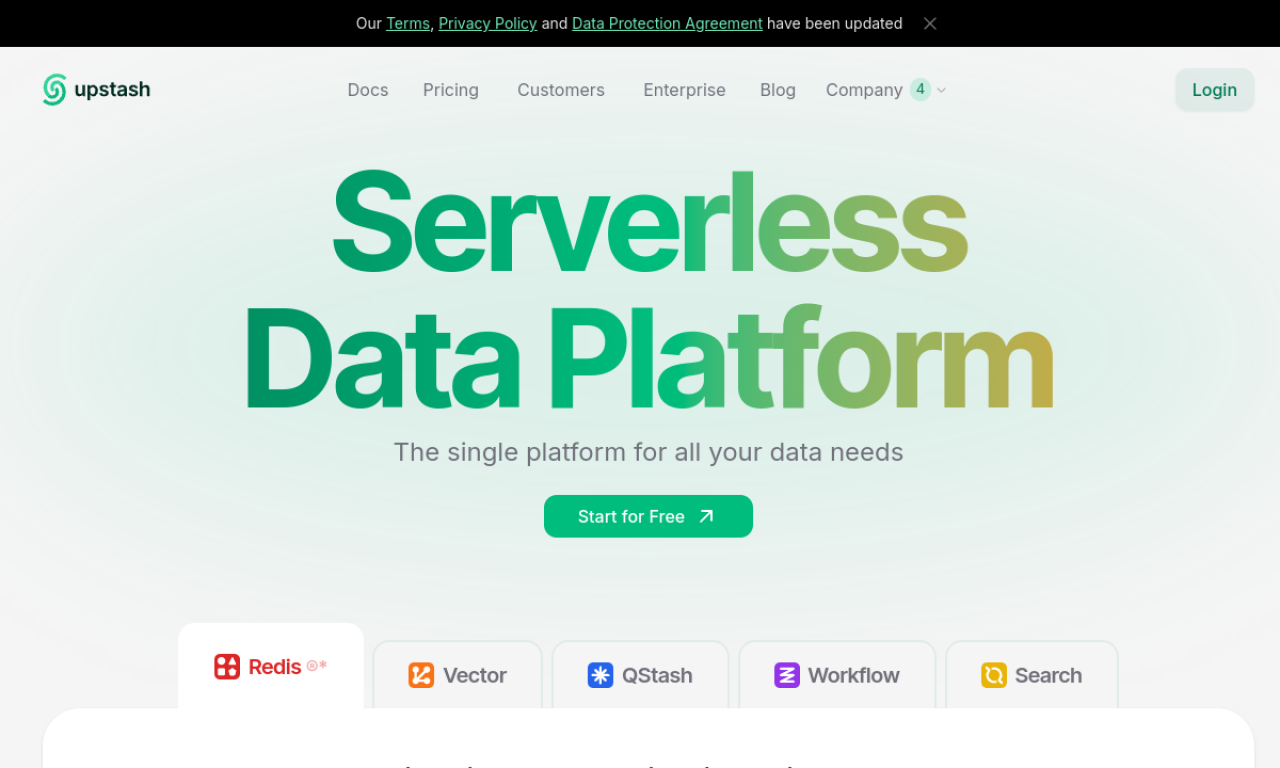
Upstash is a serverless data platform that provides managed Redis, Kafka, and vector/search capabilities optimized for edge computing and serverless architectures. Unlike traditional Redis Cloud which requires users to provision instance sizes, Upstash eliminates operational overhead through automatic scaling and per-request pricing that scales to zero. The platform offers global replication across 8+ regions with REST/HTTP APIs as a first-class interface, making it accessible from edge functions (Vercel, Cloudflare Workers) without maintaining persistent connections. It combines in-memory performance with disk persistence, providing both caching speed and durability. The service includes QStash for async job queues, Vector for embeddings, and Search for full-text indexing—positioning itself as an all-in-one data layer for modern serverless applications.
AI analysis from Feb 23, 2026
Key Features
- Serverless Redis with automatic scaling, global replication across 8+ regions, and 99.99% uptime guarantee
- REST/HTTP API access enabling direct integration from edge functions without connection pooling
- Per-request pricing model with hard cap pricing and free tier for development and low-volume usage
- QStash for reliable async messaging and job queue processing with guaranteed delivery
- Vector database and full-text search capabilities (Vector and Search products) for semantic search and embeddings
- Multi-region replication with zero-downtime region changes and data persistence with automatic backups
- Edge-optimized infrastructure tested with Vercel Edge, Cloudflare Workers, and Fastly Edge
Use Cases
- 1Session management and user authentication state in serverless APIs and edge functions
- 2Real-time leaderboards, counters, and rankings for gaming or competitive applications
- 3Rate limiting and request throttling for public APIs without managing dedicated middleware
- 4Message queue processing and async job execution with guaranteed delivery via QStash
- 5Vector similarity search and semantic retrieval for AI/LLM applications with embeddings
- 6Cache layer for frequently accessed data to reduce database load and latency
- 7Chat message storage and real-time state management for communication platforms
Pros & Cons
Advantages
- True serverless model with per-request pricing and zero-cost idle periods, eliminating capacity planning overhead that plagues traditional Redis Cloud
- Global low-latency architecture with multi-region replication and 99.99% uptime SLA, addressing the latency problem of centralized databases
- Native HTTP/REST API support enables direct integration with edge functions (Vercel, Cloudflare) without connection pooling complexity or persistent connection issues
- Unified platform consolidating Redis, Kafka, vector search, and text search reduces tool sprawl and integration complexity for data needs
- Strong developer experience with well-maintained SDKs (JavaScript, Python, etc.) and transparent cost visibility ($0.02 shown for actual usage)
Limitations
- Per-request pricing model can become expensive at high throughput compared to fixed-capacity competitors, especially for high-frequency operations like cache invalidation
- Dependency on a third-party vendor for critical data infrastructure introduces vendor lock-in risk and potential service availability concerns
- Limited documentation shown on website; success heavily depends on whether detailed guides exist for advanced use cases like complex Kafka workflows
- Regional limitations—while 8+ regions is good coverage, some geographic areas may still experience higher latency than self-hosted or competitor solutions
- REST API-only access for some features may introduce additional latency compared to native Redis protocol for high-performance scenarios requiring sub-millisecond responses
Pricing Details
Upstash offers a free tier and pay-as-you-go pricing starting at $0 for inactive services. Pricing is per-request based on storage and requests consumed (example shown: 12,004 requests with 420KB storage = $0.02/month). The website explicitly states 'Price scales to zero' and 'You'll never pay more than the cap price, guaranteed,' but specific cap limits and tiered pricing details are not fully disclosed on the homepage. Users must visit https://upstash.com/pricing for complete pricing structure.
Who is this for?
Developers and teams building serverless and edge applications on platforms like Vercel, Cloudflare Workers, or AWS Lambda who want to eliminate database operational complexity. Specifically suited for startups and scale-ups with variable traffic patterns, SaaS platforms requiring global low-latency caching, and AI/ML applications needing vector search. Also valuable for teams previously using managed Redis where capacity planning and operational overhead became burdensome. Enterprise customers are a secondary audience with dedicated support options.